Showing posts with label dinosaur. Show all posts

Sunday, November 3, 2013

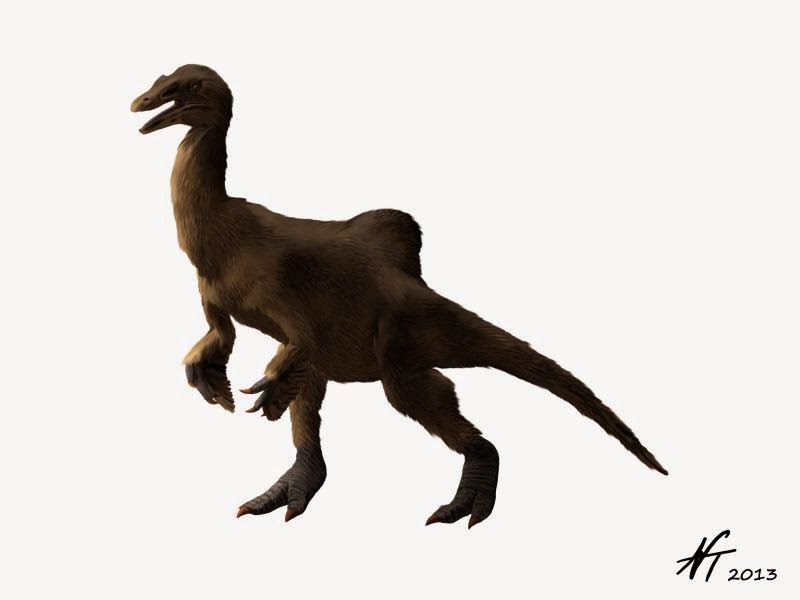
Deinocheirus the magnificent

A tentative recon of Deinocheirus while awaiting the official publication describing two new skeletons
Apparently, the mysterious Deinocheirus was more freaking awesome than you could ever have imagined... as recently revealed at SVP 2013! Here is the abstract:

New Specimens of Deinocheirus mirificus from the Late Cretaceous of Mongolia
Lee, Yuong-Nam; Barsbold, Rinchen; Currie, Philip; Kobayashi, Yoshitsugu &  Lee, Hang-Jae.

Abstract: The holotype of Deinocheirus mirificus was collected by the Polish-Mongolian Palaeontological Expedition at Altan Uul III in 1965. Because the holotype was known mainly on the basis of giant forelimbs with scapulocoracoids, Deinocheirus has remained one of the most mysterious dinosaurs. Two new specimens of Deinocheirus were discovered in the Nemegt Formation of Altan Uul IV in 2006 and Bugin Tsav in 2009 by members of the Korea-Mongolia International Dinosaur Expedition (KID). Except for the skull, middle dorsal and most of the distal caudal vertebrae, the right forelimb, left manus, and both pedes, the remaining parts of the skeleton (Mongolian Paleontological Center [MPC]-D 100/127) including a left forelimb clearly identifiable as Deinocheirus were collected. The humerus (993 mm in length) is longer than the 938 mm humerus of the holotype. The Altan Uul IV specimen (MPC-D 100/128) is a subadult Deinocheirus (approximately 72% of MPC-D 100/127), which consists of post-cervical vertebrae, ilia,ischia, and hind limbs. Both specimens provide important paleontological evidence for exact postcranial reconstruction of Deinocheirus mirificus. Cladistic analysis indicates that Deinocheirus is a basal member of Ornithomimosauria, but many new unique skeletal features appear to be quite different from other ornithomimosaurs. These include extreme pneumaticity of tall, anterodorsally oriented distal dorsal neural spines (7~8times taller than centrum height) with basal webbing, fused sacral neural spines forming a midline plate of bone that extends dorsally up to 170% of the height of the ilium, ventrally keeled sacral centra, a well-developed iliotibialis flange, a posterodorsally projecting posterior iliac blade with a concave dorsal margin, a steeply raised anteriordorsal margin of the ilium, an anteriorly inclined brevis shelf, vertically well-separatediliac blades above the sacrum, an completely enclosed pubic obturator foramen, triangular pubic boot in distal view, vertical ridges on anterior and posterior edges of medial surface of the femoral head, and a robust femur that is longer than tibiotarsus. These features suggest that Deinocheirus (unlike other ornithomimosaurs) was not a fast running animal, but a bulky animal with a heavily built pelvis and hind limbs. However,the dorsal ribs are tall and relatively straight, suggesting that the animal was narrow-bodied. A large number of gastroliths (>1100 ranging from 8 to 87 mm) were collected from the abdominal region of MPC-D 100/127, suggesting Deinocheirus was an herbivore.

Original artworks on Paleoexhibit are copyrighted to Nobu Tamura. Do not use without permission (Email: nobu dot tamura at yahoo dot com). Check out my portfolio at spinops.blogspot.com.

Monday, September 19, 2011

Talos sampsoni, a new troodontid from Utah

After the Chinese Linhevenator, yet, another troodontid, Talos sampsoni, has just been described in the current issue of PLoS ONE. This one is from the distinct and quite specific fauna of the Kaiparowits formation of Utah, which included the unique ceratopsians Kosmoceratops, Utahceratops and Nasutuceratops, the tyrannosaurid Teratophoneus, the hadrosaur Gryposaurus and the Oviraptosaur Hagryphus. Talos is essentially known from remains of the hindlimbs plus a few other bits such as some  vertebrae, and a left ulna. It was probably similar in shape to the other derived troodonts with short forelimbs, long legs and had a sickle claw on each foot.
 

References:
Lindsay E. Zanno, David J. Varricchio, Patrick M. O'Connor, Alan L. Titus and Michael J. Knell. 2011. A new troodontid theropod, Talos sampsoni gen. et sp. nov., from the Upper Cretaceous Western Interior Basin of North America. PLoS ONE 9 (6): e24487.


Sunday, September 18, 2011

Pachyrhinosaurus perotorum, new boreal dinosaur from Alaska


Fig 1.- Pachyrhinosaurus perotorum.
 
Anthony R. Fiorillo, and Ronald S. Tykoski, from the Museum of Nature and Science, Dallas, TX, have just described a new species of Ceratopsian (Horned dinosaur), Pachyrhinosaurus perotorum from the Prince Creek formation of the North Slope in the northernmost region of Alaska. The species is based on two fragments of parietals (which in Ceratopsians are the bones that formed the frill) and a partial skull.


What makes P. perotorum special is that it was a boreal dinosaur. During the Late Cretaceous, Alaska was situated at latitudes similar or higher than its current geographical position, meaning that its northern inhabitants experienced, as of today, a yearly 6 month long winter night with freezing temperature. Polar dinosaurs are also known from the southern hemisphere with representatives of the early Cretaceous period such as the hypsilophodont Leallynasaura amicagraphica from Australia featured in WWD. The Late Cretaceous Prince Creek formation of Alaska, however, appears to be the richest trove of polar dinosaur bones from either hemisphere. The Kikak-Tegoseak Quarry where the P. perotorum remains were unearthed, also include bones of the raptors Dromaeosaurus albertensis and Troodon formosus as well as remains attributed to the tyrannosaur Gorgosaurus libratus, some hadrosaurs and the Pachycephalosaur Alaskacephale gangloffi.

Fig 2.- Pachyrhinosaurus canadensis.


P. perotorum is the third named species of the genus Pachyrhinosaurus which contains Ceratopsians with massive flattened bosses in place of the usual horns on the nose and above the eyes. The larger 6 meter long P. canadensis was described in 1950. It is known from the St Mary River (Upper Campanian-Lower Maastrichtian) and Horseshoe Canyon Formations (Lower Maastrichtian) of Alberta, Canada. The smaller 5 meter long P. lakustai, described in 2008 from the Wapiti Formation (Late Campanian) of Alberta, differs from P. canadensis by well-separated nasal and supraorbital bosses and by the presence of a comb of horns on the parietal bone just behind the eyes.
 
Fig 3.- Pachyrhinosaurus lakustai.

P. perotorum is the youngest (Lower Maastrichtian) of the three species, and about the same size as P. lakustai. It is characterized by the unique anterior parietal pair of horns just at the top edge of the parietal cavities (the large holes in the frill), and a narrow dome in a back portion of the nasal boss. The bizarre blunt rounded rostrum might just be an individual oddity (the partial skull is apparently from an aged individual). A recently discovered specimen numbered TMP 2002.76.1 (Housed at the Royal Tyrrel Museum), from the Dinosaur Park Formation, Alberta, which shows similarities with both Pachyrhinosaurus and Achelousaurus, might represent a fourth species.


Pachyrhinosaurus belongs to the Pachyrhinosauri tribe of the Centrosaurine Ceratopsian that also contains the basal genera with enlarged nasal horns Einiosaurus and Rubeosaurus, as well as the derived forms with nasal and supraorbital bosses, Achelousaurus.


Original artworks on Paleoexhibit are copyrighted to Nobu Tamura. Do not use without permission (Email: nobu dot tamura at yahoo dot com)
 
References:
 
P. J. Currie, W. Langston, and D. H. Tanke. 2008. A new species of Pachyrhinosaurus (Dinosauria, Ceratopsidae) from the Upper Cretaceous of Alberta, Canada. In P. J. Currie, W. Langston Jr., D. H. Tanke (eds.), in A New Horned Dinosaur from an Upper Cretaceous Bone Bed in Alberta. NRC Research Press, Ottawa 1-108.

A.R. Fiorillo, and R.S.T. Tykoski, R.S.T.  2011. A new species of the centrosaurine ceratopsid Pachyrhinosaurus from the North Slope (Prince Creek Formation: Maastrichtian) of Alaska. Acta Palaeontologica Polonica. In press.


Monday, September 12, 2011

Linhevenator tani, a new troodontid from China

Fig 1.- Reconstruction of Linhevenator tani.

Troodontids are a family of very bird-like small theropods with long legs and enlarged braincases.  Phylogenetically, they are placed alongside the dromaeosaurs (Velociraptor, Deinonychus and friends) among the Deinonychosaurians, a sister group to the birds. Fossils of troodonts were found in Asia, Europe and North America in sediments dating from the Upper Jurassic to the Upper Cretaceous periods. Some of the better known troodonts include the Early Cretaceous Mei long (the shortest name given to a dinosaur, and meaning “sleeping dragon” because its exceptionally preserved articulated skeleton has been found in a sleeping position) and the Late Cretaceous Troodon formosus from North America, which was originally described on the basis of a single characteristic serrated tooth, but which is now known from multiple fragmentary specimens (previously referred as "Stenonychosaurus").

Fig 2.- The holotype (LH V0021) of Linhevenator tani (Xu et al., 2011). Licensed under CC 2.5. Scale bar is 2 cm.

Xing Xu and colleagues are reporting in the September 2011 issue of the open access journal PLoS ONE, a new troodontid from the Late Cretaceous Wulansuhai Formation of Bayan Mandahu, Inner Mongolia. The Wulansuhai Formation is equivalent to the famous Mongolian dinosaur bearing Djadokhta Formation of Campanian age. This new species, Linhevenator tani is known from a partly articulated skeleton that includes the skull, several vertebrae, pelvic girdle and limb elements. Although badly weathered, the remains are of particular interest are they are to date the most complete ones from a Late Cretaceous Troodontid and therefore likely to shed new lights on the more derived members of this family. Linhevenator was a rather large species (around 2-3 meters in length) characterized by rather short arms (the humeri measured only 40% of the length of the femur) and with a sickle clawed second digit on each foot similar to those of the dromaeosaurs, although these may be in fact common traits to all derived troodontids such as Troodon and Saurornithoides.

References:
Xing Xu, Qingwei Tan, Corwin Sullivan, Fenglu Han and Dong Xiao. 2011. A Short-Armed Troodontid Dinosaur from the Upper Cretaceous of Inner Mongolia and its Implications for Troodontid Evolution. PLoS ONE 6 (9): e22916


Original artworks on Paleoexhibit are copyrighted to Nobu Tamura. Do not use without permission (Email: nobu dot tamura at yahoo dot com)


Monday, September 5, 2011

Stegosaurs of the British Isles


Fig 1.- Lexovisaurus durobrivensis (= Loricatosaurus priscus)

Compared to the Stegosaurs of North America, restricted to the sole Morrison Formation and represented only by 1 or 2 genera and a handful of species, all from the Kimmeridgian-Tithonian age of the Late Jurassic, the plated dinosaurs from England appear comparatively more diversified with up to 6 genera spanning from the Middle Jurassic to the Early Cretaceous. Unfortunately, the fossils there are for the most part quite scrappy, consisting of teeth, bits of plates and other bones, making their identification difficult or even dubious.  Susannah Maidment and colleagues in their 2008 general revision of the Stegosauria, have recognized only 2 valid species to the United Kingdom, Dacentrurus armatus and the newly erected Loricatosaurus priscus, but this is certainly an underestimation. Let’s make a quick overview of stegosaurian materials found in England.

Middle Jurassic Stegosaurs

The most ancient British stegosaurs date from the Bathonian stage (165-168 MYA) of the Middle Jurassic and consist of a few isolated bones, including a massive right femur of a juvenile individual from the Cornbrah formation of Oxfordshire (Upper Batthonian), two incomplete vertebrae from the Sharp’s Hill Formation of Oxfordshire and two large dermal plates from the Chipping Norton Formation of Gloucestershire. These bones were all referred to “Lexovisaurus” vetustus (= “Omosaurus” vetustus). All that can be said is that they are the oldest recorded Stegosaurids in the world (the family to which all the most derived stegosaurs such as Stegosaurus and Kentrosaurus belong) and that a least one large species was present in Europe at that time.

Next, from the Middle Callovian (161-165 MYA) Oxford Clay Formation came Lexovisaurus durobrivensis, known from two partial skeletons. Maidment et al, 2008 have invalidated the name Lexovisaurus, on the basis that no unique character could be found in the holotype specimen. In its stead, a new genus, Loricatosaurus, was erected for the second partial skeleton that includes vertebrae, various pelvic and limb elements, and a piece of dermal armor, and folded into the species Loricatosaurus priscus. A large dermal plate named ‘Omosaurus leedsi’ from the same locality may be from the same animal. A third partial skeleton from a contemporary formation in Normandy, France is also referred to Loricatosaurus priscus. However there is no real indication that Lexovisaurus durobrivensis and Loricatosaurus priscus represent different taxa and the two might well be the same. Loricatosaurus probably measured about 5-6 meters in length. It is characterized by relatively short limbs and narrow plates and spines on the back. Shoulder spines may or may not have been present (A previously reported shoulder spine in the skeleton turns out to be a tail spine instead).

Upper Jurassic Stegosaurs
Fig 2.- Dacentrurus armatus.

From the Coralline Oolite Formation, Yorkshire, of Middle Oxfordian age (156-161 MYA), came a poorly preserved femur of a juvenile individual that has been named ‘Omosaurus phillipsi’ (= ‘Dacentrurus phillipsi’). There is no real indication that it was a stegosaur at all and the name is considered a nomen dubium (dubious name).

From the Kimmeridge Clay Formation of Wiltshire, of Lower Kimmeridgian age (151-156 MYA), came Dacentrurus armatus, a partial skeleton preserved in a large slab on exhibit at the Natural History Museum of London. Some fragmentary materials from France, Spain and Portugal were also referred to Dacentrurus. It was a large stegosaur with an estimated length of some 8 meters. Its aspect is not well known, but it probably resembled the African Kentrosaurus. From the Kimmeridge Clay also came a few dermal spines named “Omosaurus hastiger” that might belong to the same animal than Dacentrurus

Fig 3.- Dacentrurus armatus holotype on display at the Natural History Museum in London (Credit: Emőke Dénes, via Wikipedia)

Early Cretaceous Stegosaurs

From the Lower Cretaceous Wealden Beds, Sussex of Valanginian age (136-140 MYA), came a partial right mandible, Regnosaurus northamptoni, that was variously attributed to the Ornithopod Iguanodon (Mantell, 1841), the ankylosaur Hylaeosaurus (Owen, 1858), a scelidosaur (Lydekker, 1888), and even a sauropod (Ostrom, 1970) until it was discarded as a nomen dubium (Coombs, 1971). However, more recently, Barrett & Upchurch, 1995, resuscitated Regnosaurus as a stegosaur and found it to be a relict of the old stegosaurian lineage that included the Chinese Huayangosaurus. The dubious Craterosaurus pottonensis, known from a single incomplete and poorly preserved dorsal vertebra, has been described as a stegosaur, but that is probably more wishful thinking. Interestingly Craterosaurus from Bedfordshire is probably also of Valanginian age.

Fig 4.- Regnosaurus northamtoni was a close relative of Huayangosaurus taibaii.


This concludes our tour of the stegosaurian remains of England.

Original artworks on Paleoexhibit are copyrighted to Nobu Tamura. Do not use without permission (Email: nobu dot tamura at yahoo dot com)

References:

P. M. Barret & P. Upchurch. 1995. Regnosaurus northamptoni, a stegosaurian dinosaur from the Lower Cretaceous of Southern England. Geological Magazine 132: 213–222.

P. M. Galton and H.P. Powell, H. P. 1983. Stegosaurian dinosaurs from the Bathonian (Middle Jurassic) of England, the earliest record of the Family Stegosauridae. Geobios 16: 219-229.

P. M. Galton. 1985. British plated dinosaurs (Ornithischia, Stegosauridae). Journal of Vertebrate Paleontology 5(3):211-254.

S. C. R. Maidment, D. B. Norman, P. M. Barrett and P. Upchurch. 2008. Systematics and phylogeny of Stegosauria (Dinosauria: Ornithischia). Journal of Systematic Palaeontology 6(4):367-407.

Saturday, August 27, 2011

Nasutuceratops titusi, a new ceratopsian from Utah


The Kaiparowits Formation of Late Cretaceous Campanian age, in the Grand Staircase-Escalante National Monument, Southern Utah, has in recent years released a number of spectacular finds, including the ceratopsians Utahceratops and Kosmoceratops and the tyrannosaurid Teratophoneus.

This year sensation from Utah might well be another ceratopsian, Nasutuceratops titusi, known from an almost complete skull and an associated left forelimb, as well as skull fragments from two other individuals. Some skin impressions were also found with the forelimb. Nasutuceratops is still a nomen nudum (“naked name”), meaning it has not been officially and formally described in a published scientific journal yet. It has been named by Eric Karl Lund (advisor: Scott Sampson) in his Master of Science Geology thesis submitted to the faculty of the University of Utah in 2010. In a comprehensive phylogenetical analysis, this short snouted long horned centrosaurine ceratopsian was found to be closely related to the contemporary Avaceratops lammersi from Montana.


To my knowledge, the talented paleoartist Andrey Atuchin is the first one to have made a reconstruction of this intriguing animal. Mine is far from being as good as his but here it is nevertheless.

Update: it has been officially described in 2013 as Nasutoceratops titusi by Sampson et al (with an "o" instead of a "u").

Ref: Sampson, S. D., Lund, E. K., Loewen, M. A., Farke, A. A, Clayton, K. E. 2013. A remarkable short-snouted horned dinosaur from the Late Cretaceous (late Campanian) of southern Laramidia. Proceedings of the Royal Society B: Biological Sciences 280 (1766) 20131186.

Original artworks on Paleoexhibit are copyrighted to Nobu Tamura. Do not use without permission.


Tuesday, August 9, 2011

Xiaotingia zhengi or is Archaeopteryx still a bird?


Fig 1.- A reconstruction of Xiaotingia zhengi.

Xiaotingia zhengi is a new small carnivorous theropod dinosaur discovered in the Late Jurassic Tiaojishan Formation of the western Liaoning province of China. It is known from a single articulated skeleton missing the tail and part of the left leg, and preserved in a slab that also contains some feather impressions.

Fig 2.- Anchiornis huxleyi, a taxon previously described as a troodont, is closely related to Xiaotingia and Archaeopteryx.

The intriguing part of the story published last month in the journal Nature is less the description of the new fossil itself than the resulting cladistic analysis that followed. Xiaotingia was found to be closely related to the famous dinosaur-bird transitional fossil Archaeopteryx lithographica from Bavaria, Germany, and to another taxon described in 2009, Anchiornis huxleyi. Anchiornis had its share of fame last year when it became the first dinosaur to reveal its true colors from the examination of fossilized pigments found in the feather impressions. But Anchiornis was at that time classified as a flying dinosaur belonging to the troodontid family.

Fig 3.- Archaeopteryx lithographica, the "ancestral" bird, was actually a deinonychosaurian dinosaur related to Velociraptor. Note, the position of the wings is too high in this reconstruction.

The new cladistic tree proposed by Xing Xu and colleagues places Archaeopteryx, Anchiornis and the novel taxon Xiaotingia within the same family, the Archaeopterygidae and nests them at the base of the Deinonychosaurians, the group that contains such celebrities as Velociraptor, Deinonychus, Troodon and Utahraptor, and away from the ‘sister” branch (the Avialae) that lead to the modern birds. Archaeopterygidae is then a third and the most basal family that constitutes the Deinonychosaurians, along with the more derived Troodontids (Troodon and friends) and Dromaeosaurs (Velociraptor and friends). The real story behind the discovery of Xiaotingia is therefore that it knocks Archaeopteryx out of the genealogical tree that lead to the modern birds, a position that it held for a century and half! The true ancestors of birds, were more closely related to such oddities as the strange Scansoriopteryids and perhaps other dinosaurs such as the beaked Oviraptosaurs. This leads to the interesting possibility that an herbivorous rather than a carnivorous diet was an ancestral trait for birds.

Fig 4.- Phylogenetic tree of the ancestor of birds and their closest relatives (After Xu et al., 2011). Archaeopteryx does no longer belongs to Aves (Birds in the traditional sense).

As a matter of fact, the position of Archaeopteryx as the ancestor of all birds was precarious for some times now. The close relationship of Archaeopteryx with the Deinonychosaurians has been suspected for quite a while, with such discoveries as the four-winged flying sensation called Microraptor and other small “dromies”. The new cladistic analysis is just confirming a trend that started some two decades ago. Overall the new analysis by Xu and colleagues is making perfect sense: a number of traits that Archaeopteryx possesses are more akin to Deinonychosaurians than to Avialians. Archaeopteryx for instance has a slender shallow snout like the Deinonychosaurians and quite unlike basal avialians such as Epidexipteryx and Sapeornis and Oviraptosaurs who tend to have short and blunt snouts. Many details of the skeletal anatomy, such as the dimension and shape of the different openings in the skull (antorbital fenestra, premaxillary fenestra, …) shape and proportions of different bones (such as the lacrimal in the skull, the pubis, metatarsals, etc…) all point to Deinonychosaurian affinities for the Archaeopterygids.

Now to the vexed question as whether Archaeopteryx could still be considered a bird or not, the most we can say is that it all depends on how you define “bird”. In the traditional sense (as “birds”=Aves), Archaeopteryx is not a bird anymore. But using a broader definition (for instance, “birds”= Paraves (Avialae+ Deinonychosauria)), Archaeopteryx would still be considered a bird, but so should be all Archaeopteryx closest relatives, Velociraptor, Microraptor, Deinonychus and co. Anyway, the fact that a small feathered dinosaur related to Velociraptor could have been mistaken for the  “Urvogel”, the ancestral bird for well more than a century, tellingly shows how intimate the connection between the two groups is. Birds really are the last surviving group of dinosaurs, so get over it and move on, folks!


References:
Xing Xu, Hailu You, Kai Du and Fenglu Han. 2011. An Archaeopteryx-like theropod from China and the origin of Avialae. Nature 475: 465–470.


Original artworks on Paleoexhibit are copyrighted to Nobu Tamura. Do not use without permission.

Wednesday, July 13, 2011

How many Stegosaurs in the Morrison Formation?


Fig 1.- Stegosaurus ungulatus.
Stegosaurus is one of the most iconic dinosaurs from the famed Late Jurassic Morrison Formation of North America. Artists have often depicted the plated “roofed lizard” as the formidable opponent to its nemesis, the fearsome theropod Allosaurus. The first remains of a stegosaur have been unearthed in Colorado during the Bone Wars and described by Othniel Charles Marsh in 1977 as Stegosaurus armatus. Since then, numerous specimens were found and described from different areas encompassing the Morrison Formation, in Colorado, Wyoming and Utah. Of the 11 or so names that were given to stegosaur remains from the United States, Marsh has described no less than 7 species.
Fig 2.- Hesperosaurus mjosi

But subtle differences seen in the bones can either be signatures of different species or simply reflect individual variations within the same species. How to define characteristics that are unique to a given species (autapomorphies) is easier said than done when the number of specimens is limited and when remains are fragmentary (i.e. statistics is lacking).
Fig 3.- Stegosaurus stenops

In a 2008 review of all stegosaurs, Susannah Maidment and colleagues made some very drastic cuts in the number of species present in the Morrison formation, recognizing only two valid ones: Stegosaurus armatus and Hesperosaurus mjosi that they renamed Stegosaurus mjosi. The other species are either junior synonyms of S. armatus or dubious (nomen dubium). However in another case of the now classic opposition between “splitters” (scientists who think there is only a narrow range of variation inside a species, thus considering more species as valid) and “lumpers” (scientists who think that there are few species with large individual variations), Peter Galton and colleagues in a 2010 paper had a closer look on the various remains from the Morrison formation and found that up to 7 species must be considered valid. To add a little twist to the story, they infer that the type species, Stegosaurus armatus, is a nomen dubium due to the fragmentary nature of the holotype that does not allow defining any autapomorphy. But if S. armatus were unvalidated, so would be the genus name, Stegosaurus. Consequently, a petition to the ICZN (International Commission of Zoological Nomenclature) was filed to make the best-known species, Stegosaurus stenops as the new type for the genus (good choice, nobody really wants our favorite plated lizard to be renamed Hypsirophus or Diracodon !).
Fig 4.- Stegosaurus longispinus, here depicted as a Kentrosaurus grade species

In view of the diversity of Ornithopods and Sauropods in the Morrison formation, it is not that surprising to see more than one species of stegosaurs living at the same time there. If we discard the species that are either too fragmentary or not properly described, we end up with some 4 or 5 different stegosaurs in North America. Among them, Hesperosaurus mjosi is the oldest, having been found close to the base of the formation. It is easily distinguishable by the plates, which are longer than taller. Stegosaurus stenops is the best known with several almost complete skeletons.  It is characterized by three unpaired alternating dermal plates just before the spikes while Stegosaurus ungulatus has three pairs of small dermal plates there. Interestingly, remains of a stegosaur from Portugal have tentatively been assigned to this particular species. Stegosaurus sulcatus with its large based tail spikes might also be another valid species.

Stegosaurus longispinus, characterized by longer tail spines or “thagomizer” is only known from materials from the rear of the animal, which were unfortunately mostly destroyed in the early 1920s. Because of the longer tail spines, some have argued that S. longispinus might have been a Kentrosaurus-like stegosaur, which would need to be redescribed as a new genus.

Note: as I am writing this, I realized this story was already covered much more eloquently and in depth by paleontologist Darren Naish a few months earlier (see his post here)…


References:

S. C. R. Maidment, D. B. Norman, P. M. Barrett and P. Upchurch. 2008. Systematics and phylogeny of Stegosauria (Dinosauria: Ornithischia). Journal of Systematic Palaeontology 6(4):367-407.

P. M. Galton, 2010. Species of plated dinosaur Stegosaurus (Morrison Formation, Late Jurassic) of western USA: new type species designation needed. Swiss Journal of Geosciences 103, 187-198.

Thursday, June 23, 2011

A thermometer to measure dinosaur body temperature: scientists show direct evidence of warm-bloodedness in giant sauropods

It was speculated for a few decades now that dinosaurs were endotherm (warm-blooded) creatures with high metabolism rates, comparable to birds and mammals. But all the gathered evidences were so far indirect and quite speculative. These include the fact that dinosaurs also thrived in polar climates, or that the spacing in dinosaur tracks show that they were able to run pretty fast.

Now a team of scientists from Caltech led by John Eiler found a way to directly measure the body temperature of long extinct animals. The team measured the concentrations of the rare isotopes carbon 13 and oxygen 18 in the mineral bioapatite found in dinosaur teeth. These isotopes would bond (“clump”) together more often with lower temperature, so measuring the clumping of the two isotopes can precisely tell the temperature the teeth were at when the animal was alive.

The method was applied to well preserved teeth of big upper Jurassic sauropods (Brachiosaurus and Camarasaurus) and the results show that their body temperature ranged between 36 to 38 ºC, which are comparable to mammals but a bit lower than what would have been predicted if endothermy were solely due to the gigantic size of these dinosaurs. This is an indication that sauropods must have developed efficient physiological or behavioral ways to regulate their body temperature to prevent overheating.

The idea is now to use the isotopic thermometer to measure the body temperature of a larger set of extinct animals, including the smaller dinosaurs that can't rely on size for endothermy.

References:

Robert A. Eagle, Thomas Tütken, Taylor S. Martin, Aradhna K. Tripati, Henry C. Fricke, Melissa Connely, Richard L. Cifelli, and John M. Eiler, 2011, “Dinosaur Body Temperatures Determined from Isotopic (13C-18O) Ordering in Fossil Biominerals” Science, advanced online publication.

Saturday, June 18, 2011

Arcusaurus pereirabdalorum, a new sauropodomorph dinosaur from the Early Jurassic of South Africa


Sauropodomorphs form a group of bipedal and quadrupedal herbivorous dinosaurs that reached gigantic proportions in the Jurassic and Cretaceous periods with the likes of Diplodocus, Argentinosaurus and Brachiosaurus. The Upper Elliot Formation of Early Jurassic age in South Africa is home of at least three species of sauropodomorphs. The best known is Massospondylus carinatus, with several specimens uncovered. The two other species are Massospondylus kaarae and Aardonyx celestae, both named very recently, while the status of Gryponyx africanus is unclear, and of Ignavusaurus rachelis, dubious.

Yet, another species, Arcusaurus pereirabdalorum, the smallest of them all, has been added to the list. Scattered remains of at least two individuals, probably juveniles, have been unearthed.
The generic name, which means “Rainbow lizard”, honors the people of South Africa, the “rainbow nation”. Interestingly, Arcusaurus, albeit its Plateosaurus-like deep snout, in the analysis looks very basal and came as a sister taxon of the triassic sauropodomorphs such as Thecodontosaurus and Efraasia. If this were the case, Arcusaurus would be a relict of the primitive Triassic sauropodomorphs that somehow made it to the Jurassic.

Adam M. Yates, Matthew F. Bonnan, and Johann Neveling have described the species in the May 2011 issue of the Journal of Vertebrate Paleontology.


References:

Barrett, P. M. 2009. A new basal sauropodomorph dinosaur from the upper Elliot Formation (Lower Jurassic) of South Africa. Journal of Vertebrate Paleontology 29:1032–1045.

Yates, A. M., M. F. Bonnan, J. Neveling, A. Chinsamy, and M. G. Blackbeard. 2010. A new transitional sauropodomorph dinosaur from the Early Jurassic of South Africa and the evolution of sauropod feeding and quadrupedalism. Proceedings of the Royal Society B 277:787–794.

Yates, A.M.,  M. F. Bonnan, and J. Neveling. 2011. A New Basal Sauropodomorph Dinosaur from the Early Jurassic of South Africa. Journal of Vertebrate Paleontology, 31(3):610-625.

Saturday, June 11, 2011

Haya griva, a new dinosaur from the Late Cretaceous of Mongolia

Haya griva was named after the Hindu deity Hayagriva, an avatar of Vishnu characterized by a horse head. This is in reference to the horse-like elongated skull of this little dinosaur, the remains of which were recovered from the Late Cretaceous Javkhlant Formation in Mongolia of probable Santonian age.

Haya griva is a basal ornithopod, one of the many small herbivorous bipedal bird-hipped dinosaurs that were a common occurrence in the Cretaceous period throughout the world. Some well-known basal ornithopods include Hypsilophodon from Europe and Leallynasaura of Australia (featured in the 5th episode, “Spirits of the Ice Forests” of the WWD franchise). However, basal ornithopods are relatively rare in Asia, represented only by the Early Cretaceous genera Jeholosaurus and Changchungsaurus from China. Haya griva is the first named of this kind from the Late Cretaceous Asia. It is unclear if this apparent low diversity is real or due to sampling bias.

Another interesting fact about Haya griva is that one of the specimen was found with a large gastrolith in its stomach (stone swallowed by herbivorous animals to help them with digestion), only the second recorded gastrolith found in ornithopods. Haya griva is known from remains of 8 individuals at different ontological stages, including several skulls and one well preserved partial articulated postcranial skeleton.

The new genus was described by Peter J. Makovicky, Brandon M. Kilbourne, Rudyard W. Sadleir, and Mark A. Norell in the May issue of the Journal of vertebrate Paleontology.


References:

Makovicky, P.J., B. M. Kilbourne, R. W. Sadleir, and M. A. Norell. 2011. Journal of Vertebrate Paleontology, 31(3):626-640.

Sunday, April 17, 2011

Daemonosaurus chauliodus

Daemonosaurus chauliodus

The Evil Spirit lizard haunts theropod phylogeny

Meet Daemonosaurus chauliodus, a newly discovered theropod dinosaur from the Chinle Formation of the “Coelophysis Quarry” at Ghost Ranch in New Mexico. Its description by Hans-Dieter Sues, Sterling J. Nesbitt, David S.  Berman and Amy C. Henrici, has just been published in the Proceedings of the Royal Society B (Sues et al., 2011).

Fig 1.- A reconstruction of the head of Daemonosaurus. The fur is speculative.

The media has readily dubbed this little critter as the “Bucked-toothed Demon Lizard” but there is actually nothing devilish about the look of the 
animal. The intended meaning of the generic name is in fact a bit different: the authors used the Greek word daimon in its original sense of ‘evil spirit’ and allude to legends about evil spirits haunting Ghost Ranch, the place of discovery. The specific name, derived from the Greek chauliodous and which means ‘with prominent teeth’ is shared with the scientific name of the deep-sea viperfish (Chauliodus sloani). Like the viperfish, Daemonosaurus is indeed characterized by a set of much enlarged fang-like front teeth. Such teeth might be an indication of a specialized diet, but at this point, we don’t have a clue of what it was.

The prominent teeth are not the only things remarkable about this critter. Daemonosaurus is also one of the most primitive theropod which makes him all the more important as the early history of this particular group of dinosaurs is somewhat sketchy. We know that by the Late Triassic Carnian age (216.5-228 MYA) , the three principal lineages of dinosaurs, i.e. the theropods, the sauropodomorphs and the ornithischians were already well differentiated. A sample of the earliest theropods, i.e. Herrerasaurus, Staurikosaurus, Eoraptor and the recently described Eodromaeus (Martinez et al., 2011) and Sanjuansaurus (Alcober et al., 2010) were found in South America in the Ischigualasto Formation of Argentina and the Santa Maria Formation of Brazil. These primitive theropods still retained five digits on both their hands and feet (albeit greatly reduced fifth digits), while the Neotheropoda, a group that contains all the most advanced theropods including Tyrannosaurus, Velociraptor and the birds, had only three digits in their hands (with sometimes a vestigial fourth as in Coelophysis; in T. rex the 3rd digit is also vestigial), and three functional digits per feet (the fifth is vestigial and the first, is reduced to a “dew claw” on the inside or back of the foot).

Until recently, the later Norian and Rhaetian stages of the Late Triassic (199.6 to 216.5 MYA) have only yielded Neotheropods belonging to a single group called Coelophysoidea (some examples include Coelophysis of WWD fame, Segisaurus, Lilensternus and most probably Zupaysaurus), with the sole exception of the enigmatic Chindesaurus from Arizona which is difficult to classify due to the fragmentary nature of its remains (Nesbitt et al., 2007) but which is now generally considered a late survivor of the Herrerasaurus tribe. The evolutionary gap between the early theropods and the neotheropods started to be filled a couple of years ago with the description of a new species, Tawa hallae (Nesbitt et al., 2009), also from the Ghost Ranch locality of New Mexico and that has been shown to be intermediate between the herrerasaurs and the neotheropods. And this year, we have Daemonosaurus.

Fig 2.- Reconstructed skulls of Daemonosaurus chauliodus (top) and Tawa hallae (bottom). Based after Nesbitt et al., 2009 & Sues et al., 2010. Note the shorter snout and proportionally longer front teeth and larger orbital fenestrae of Daemonosaurus.

Daemonosaurus appears to be even more primitive than Tawa. The holotype consists of a crushed skull, vertebrae and ribs, found in the so-called Coelophysis quarry of Rhaetian age (Stewart et al., 1972). The fossil was indeed extracted from a large block containing remains of several Coelophysis bauri, and there is a chance that more postcranial remains of Daemonosaurus will turn up after completion of the preparation of the block. With its short and deep skull equipped with pointy teeth, Daemonosaurus look is surprising, unlike any of the other basal theropods. The structure of the cervical vertebrae indicates that it probably had a long neck like Tawa or Coelophysis. Like most of the other theropods of the Late Triassic, it was pretty small, measuring perhaps no more than 1.5 meters.

It now appears that the theropod fauna of the Late Triassic was far more diverse than originally thought. Due to its unusual skull shape and teeth, Daemonosaurus was however probably not a transitional form to the new theropods but an evolutionary dead-end that left no descendant.

References:

Alcober, O. A.; and Martinez, R. N. 2010. A new herrerasaurid (Dinosauria, Saurischia) from the Upper Triassic Ischigualasto Formation of northwestern Argentina. ZooKeys 63: 55–81.

Martinez, R. N., Sereno, P. C., Alcober, O. A., Colombi, C. E., Renne, P. R., Montan˜ ez, I. P. & Currie, B. S. 2011. A basal dinosaur from the dawn of the dinosaur era in southwestern Pangaea. Science 331, 206–210.


Nesbitt, S. J., Irmis, R. B. & Parker,W. G. 2007 A critical re-evaluation of the Late Triassic dinosaur taxa of North America. J. Syst. Palaeontol. 5, 209–243.


Nesbitt, S. J., Smith, N. D., Irmis, R. B., Turner, A. H., Downs, A. & Norell, M. A. 2009 A complete skeleton of a Late Triassic saurischian and the early evolution of dinosaurs. Science 326, 1530–1533.


Stewart, J. H., Poole, F. G. & Wilson, R. F. 1972 Stratigraphy and origin of the Chinle Formation and related Upper Triassic strata in the Colorado Plateau region. US Geol. Surv. Prof. Pap. 690, 1–336.


Sues, H.-D.; Nesbitt, S.J.; Berman, D.S.; and Henrici, A.C. 2011. A late-surviving basal theropod dinosaur from the latest Triassic of North America. Proceedings of the Royal Society B in press

Sunday, April 10, 2011

Manidens condorensis


Introducing Manidens condorensis, a new Heterodontosaur from the Middle Jurassic of Patagonia...

Fig 1.- My reconstruction of Manidens condorensis.

Some critters have a mysterious appeal, which is difficult to explain. I always felt some fondness for a meter long creature named Heterodontosaurus from the Early Jurassic of South Africa. If you ignore my now lost childhood productions, it is among the first dinosaurs I’ve drawn. So I was naturally very thrilled to learn that yet another relative of Heterodontosaurus, the Patagonian Manidens condorensis has just been unearthed from the Cañadón Asfalto Formation of Middle Jurassic age. Diego Pol, Olivier W.M. Rauhut and Marcos Becerra are describing the new species in a paper about to be published in Naturwissenshaften.

Fig 2.- Old (2007) pencil sketch of Heterodontosaurus tucki in quadrupedal pose, one of the first dinosaur I’ve drawn during my adult life. Yes, I know, it was not very good, just for reference...

Heterodontosaurus and Manidens belong to a small group of ornithischian (bird-hipped) dinosaurs called heterodontosauridae. In the world dominated by giants, these critters were comparatively very tiny. The largest representative, Lycorhinus angustidens, also from the Early Jurassic of South Africa and mainly known from dentaries, had an estimated length of only 2 meters, while Fruitadens haagarorum from the Upper Jurassic of Colorado, with an estimated length of 65-75 cm has been dubbed the smallest known ornithischian at the time of its discovery.

Heterodontosaurs are also characterized by their highly differentiated teeth, thus the meaning of their name (“different-toothed lizards”). They have a pair of well-developed tusk-like canines on the lower jaw that are accommodated by a gap (diastema) in the upper jaw when the mouth is closed. They also have highly derived cheek teeth that are, in the most derived forms, columnar in shape with almost no space in between, reminiscent of the mammalian molars. The toothless tip of the upper jaw may also have supported a beak. All in their teeth cry for a preferential vegetarian diet. What did they look like? Before Tianyulong (see below), representations of heterodontosaurs were based on the only complete skeleton known for the group, i.e the Heterodontosaurus tucki specimen SAFM K1332 housed in the South African Museum (Santa Luca, 1980). They were lightly built and had a very long tail. The arms were quite long for a dinosaur with hands having all five digits. The leg proportions tibia/femur show adaptation for speed, indicating they were probably agile bipedal runners.

Fig 3.- Cast of the Heterodontosaurus tucki specimen SAFM K1332. By Flickr user kyknood uploaded on Wikipedia by user Funkmonk under a Creative Common License.

Heterodontosaurs are a rare find and little was known of their affinities until quite recently. This is due not only to the scarcity of their remains but also to the large gaps in the fossil record of early ornithischians (there were simply not many other critters to compare to). Before Y2K, only three species were known with high degree of confidence, Heterodontosaurus tucki, Abrictosaurus consors and Lycorhinus angustidens, all from the Early Jurassic of Southern Africa, with in addition some dubious taxa, Lanasaurus, Geranosaurus both from South Africa and the enigmatic Echinodon becklesii from the Early Cretaceous of England known from a jaw fragment with teeth, which might or might not be an heterodontosaur (Norman & Barrett, 2002). Recent studies all place Echinodon outside the heterodontosaur clade.

Fig 4.- Illustration of Heterodontosaurus tucki, adult and juveniles indicating a probable omnivorous diet, made for the press release following the publication of Butler et al., 2008b.

However things changed quickly and quite dramatically in the last few years. All the previous indubitable heterodontosaurs were from the Early Jurassic of South Africa. Discoveries from the new millennium have considerably extended the temporal and geographical range for the group, covering the Late Triassic of South America (Báez & Marsicano, 2001), the Early Cretaceous of China (Zheng et al., 2009) and the Upper Jurassic of North America (Butler et al., 2010).

As for their systematic affinities, scientists in the past have variously placed them as an early but highly specialized sister taxon to the marginocephalians (ceratopsians and pachycephalosaurs) or as the most basal members of ornithopods. Recent phylogenetic analyses indicate that they actually represent an early offshoot of basal ornithischians (Butler et al., 2008a) and this seems to be comfortably confirmed by subsequent studies (Butler et al., 2010, Zheng et al., 2009, Pol et al., 2011). The presence of the canine-like teeth in a juvenile specimen of Heterodontosaurus also questioned the previous assertions that these tusks were a mark of sexual dimorphism and primarily used for sexual display (Butler et al., 2008a). Not so sure, what to do with the tusk less specimen of Abrictosaurus, now... but it is also true that there is a need to revise the South African materials (What a perfect paleontology PhD subject, any taker?) Finally, heterodontosaurs experienced a drastic change of look after the discovery of a remarkably well-preserved specimen from the Liaoning province of China (Zheng et al., 2009). Indeed, the fossil of Tianyulong confuciusi has clear impressions of filamentous integuments covering the body like a fur. They may be analogous to the proto-feathers found in theropods and the quills found on the basal ceratopsian Psittacosaurus. Well, no more scaly and skinny heterodontosaur, time for fuzzy Mesozoic furry balls…

Fig 5.- Complete view of Manidens condorensis.

The holotype of Manidens condorensis is a partial associated skeleton including most of the skull, the anterior part of the vertebral column, pelvic girdles, left scapula and coracoids. Referred materials include a set of teeth. The phylogenetic analysis conducted by Pol et al., indicates that it is more derived than Tianyulong and Fruitadens but slightly less than the South African genera. The teeth of Manidens are also quite interesting. Whereas the more derived members of the heterodontosaurs such as Heterodontosaurus show clear adaptation for an herbivorous diet (closely packed teeth, high tooth crowns, and extensive wear facets on the maxillary and dentary teeth), the basal members lack those, pointing to a more omnivorous diet. But Manidens is in an intermediate stage with high tooth crowns but no wear facets. Basal members of heterodontosaurs were probably ecological generalists that fed on miscellaneous diet including plants but also small animals such as invertebrates.
Manidens was extremely small for a dinosaur, Pol et al., give it a size comparable to Fruitadens, but I believe it might have been a bit smaller if I trust the scales indicated in the figures of their respective articles. The examination of the holotype skeleton of Manidens indicates that it is from an old adult, despite its small size and comparatively large eye socket, while the material from Fruitadens are based on juveniles.

Fig 6.- Comparison of the skulls (only known parts are represented) of different heterodontosaurs, drawn to scale. a) Fruitadens haagarorum [modified from Butler et al., 2010], b) Tianyulong confuciusi [modified from Zheng et al., 2010], c) Abrictosaurus consors [modified from...(forgot the ref)] note the lack of tusks, this was interpreted as belonging to a female, d) Manidens condorensis [modified from Pol et al., 2010], e) Heterodontosaurus tucki [modified from Butler et al, 2008b]

There are still a lot of mysteries surrounding these critters due to the large gap in their fossil record. For instance, the most derived members from South Africa all date from the Early Jurassic, while the most primitive and less specialized member, Tianyulong, is from the Early Cretaceous. Did the more derived strictly herbivorous members went extinct out-competed by new groups of hungry ornithischians, while the more primitive unspecialized and opportunistic members survived because they could do a meal from almost anything? Who knows? It was also originally thought that the group originated in the Gondwana where the most primitive and earliest ornithischian, Pisanosaurus mercki, has been found but with the discovery of Tianyulong from China and Fruitadens from North America, all the cards are reshuffled. Looking forward to the next big heterodontosaurian discovery…

Fig 7.- Phylogeny of heterodontosaurs [adapted from Pol et al., 2011].

References:
Báez A.M., Marsicano C.A. 2001. “A heterodontosaurid ornithischian dinosaur from the Upper Triassic of Patagonia”. Ameghiniana 38:271–279.

Butler, R. J., Upchurch, P. & Norman, D. B. 2008a “The phylogeny of the ornithischian dinosaurs”. J. Syst. Palaeontol. 6, 1–40.

Butler R.J., Porro L.B., Norman D.B. 2008b. “A juvenile skull of the heterodontosaurid dinosaur Heterodontosaurus tucki from the ‘Stormberg’ of southern Africa”. J Vert Paleont 28:702–711.

Butler R.J., Galton P.M., Porro L.B., Chiappe L.M., Henderson D.M., Erickson G.M. 2010. “Lower limits of ornithischian dinosaur body size inferred from a new Upper Jurassic heterodontosaurid from North America”. Proc R Soc B 277:375–381.

Norman, D. B. & Barrett, P. M. 2002. “Ornithischian dinosaurs from the Lower Cretaceous (Berriasian) of England”. Spec. Papers Palaeontol. 68, 161–189.

Pol, D.; Rauhut, O.W.M.; and Becerra, M. 2011. "A Middle Jurassic heterodontosaurid dinosaur from Patagonia and the evolution of heterodontosaurids". Naturwissenschaften in press.

Santa Luca, A. P. 1980. “The postcranial skeleton of Heterodontosaurus tucki (Reptilia, Ornithischia) from the Stormberg of South Africa”. Ann. South Afr. Mus. 79, 159–211.

Thulborn, R. A. 1970. “The systematic position of the Triassic ornithischian dinosaur Lycorhinus angustidens”. Zoo. J. Linn. Soc. 49, 235–245.

Zheng, X.-T., You, H.-L., Xu, X. & Dong, Z.-M. 2009. “An Early Cretaceous heterodontosaurid dinosaur with integumentary structures”. Nature 458, 333–336.