Showing posts with label paleontology retrospective. Show all posts

Wednesday, January 1, 2014

2013 in Paleontology


A selection of species described in 2013
Here is my pick for the top paleontology stories of year 2013 (not in particular order):

Archicebus achilles
1) The discovery in the Hubei province of China of the oldest haplorhine primate skeleton, Archicebus achilles., dating from the Eocene.
Reference: Ni, X.; Gebo, D. L.; Dagosto, M.; Meng, J.; Tafforeau, P.; Flynn, J. J.; Beard, K. C. 2013. The oldest known primate skeleton and early haplorhine evolution. Nature 498 (7452): 60–64.


Entelognathus primordialis

2)Entelognathus primordialis, a Placoderm fish with a modern type jaw that rewrites the history of jaw evolution in vertebrates.
Reference: Zhu, Min; Xiaobo Yu, Per Erik Ahlberg, Brian Choo, Jing Lu, Tuo Qiao, Qingming Qu, Wenjin Zhao, Liantao Jia, Henning Blom & You'an Zhu 2013. A Silurian placoderm with osteichthyan-like marginal jaw bones. Nature (502): 188–193.

3) A new study using computer mechanical simulation coupled with high resolution CT scans has indicated that theropod dinosaur beaks evolved to stabilize the skull during biting and feeding rather than as a lightweight replacement for teeth as previously assumed.
Microraptor gui
Reference: Lautenschlager, Stephan et al. 2013. Edentulism, beaks, and biomechanical innovations in the evolution of theropod dinosaurs. PNAS. in press.

4) Microraptor gets a highlight again with the description of a specimen with fish scales in its abdominal cavity proving that it was an opportunistic feeder that also was also piscivorous.
Reference: Lida Xing et al. 2013. Piscivory in the feathered dinosaur Microraptor. Evolution. 67(8): 2441–2445.
Tsintaosaurus spinorhinus
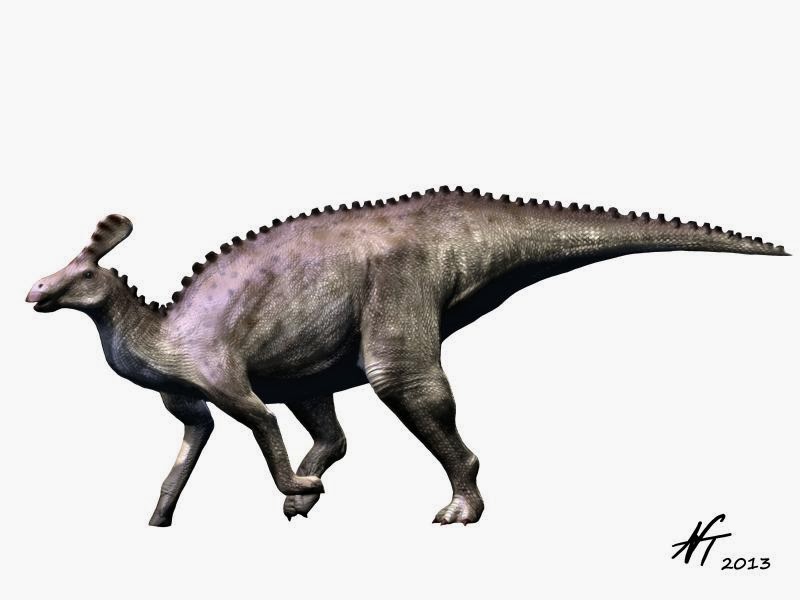
5) Two familiar duck-billed dinosaurs got facelifts with the redescription of the crest of Tsintaosaurus and the finding of a soft tissue wattle on the head of one well preserved specimen of Edmontosaurus.
Reference: Prieto-Márquez, A.; Wagner J.R. 2013. The ‘Unicorn’ Dinosaur That Wasn’t: A New Reconstruction of the Crest of Tsintaosaurus and the Early Evolution of the Lambeosaurine Crest and Rostrum.. PLoS ONE 8 (11): e82268.

Bell, P. R.; Fanti, F.; Currie, P. J.; Arbour, V. M. 2013. A Mummified Duck-Billed Dinosaur with a Soft-Tissue Cock's Comb. Current Biology. in press.
Edmontosaurus regalis

6) A new methodology has clocked the rate of evolution of arthropods and it was found to be four to five times faster during the so-called "Cambrian explosion" than after it.
Reference: Michael S.Y. Lee, Julien Soubrier, Gregory D. Edgecombe, Rates of Phenotypic and Genomic Evolution during the Cambrian Explosion, Current Biology, Volume 23, Issue 19, 7 October 2013, Pages 1889-1895.

Lythronax argestes
7) At 8 meters in length, the tyrannosaurid Lythronax argestes from the Cretaceous of Utah emerges as the new rising star among the dinosaur enthusiasts and t-rex lovers.
Reference: Loewen, M. A.; Irmis, R. B.; Sertich, J. J. W.; Currie, P. J.; Sampson, S. D. 2013. Tyrant Dinosaur Evolution Tracks the Rise and Fall of Late Cretaceous Oceans. In Evans, David C. PLoS ONE 8 (11): e79420.

8) Three new ceratopsians from North America have been described: Bravoceratops from Texas, Nasutoceratops from Utah and Judiceratops from Montana.
Judiceratops tigris
Reference: Longrich, N. R. 2013. Judiceratops tigris, a New Horned Dinosaur from the Middle Campanian Judith River Formation of Montana. Bulletin of the Peabody Museum of Natural History 54: 51–65.

Sampson, S. D.; Lund, E. K.; Loewen, M. A.; Farke, A. A.; Clayton, K. E. 2013. A remarkable short-snouted horned dinosaur from the Late Cretaceous (late Campanian) of southern Laramidia. Proceedings of the Royal Society B: Biological Sciences 280 (1766): 2013118.

        Wick, S. L.; Lehman, T. M. 2013. A new ceratopsian dinosaur from the Javelina Formation (Maastrichtian) of West Texas and implications for chasmosaurine phylogeny". Naturwissenschaften. in press (7): 667.


Panthera blytheae
9) Panthera blytheae from the Late Miocene of Tibet is the oldest known big cat (genus Panthera) that includes lions, tigers, panthers, leopards and jaguars, and points to an asian origin for them.
Reference: Tseng, Jack; Wang, Xiaoming; Slater, Graham J. ; Takeuchi, Gary T. ; Li, Qiang; Liu, Juan; and  Xie, Guangpu. 2014. Himalayan fossils of the oldest known pantherine establish ancient origin of big cats. Proceedings of the Royal Society B 281 (1774): 20132686.
10) Rock legend Jim Morrison has now a prehistoric animal named after him, the 2 meter long iguana relative, Barbaturex morrisoni.
Barbaturex morrisoni
Reference: Head, J. J.; Gunnell, G. F.; Holroyd, P. A.; Hutchison, J. H.; Ciochon, R. L. 2013. Giant lizards occupied herbivorous mammalian ecospace during the Paleogene greenhouse in Southeast Asia. Proceedings of the Royal Society B: Biological Sciences 280 (1763): 20130665.

Original artworks on Paleoexhibit are copyrighted to Nobu Tamura. Do not use without permission (Email: nobu dot tamura at yahoo dot com)

Tuesday, January 1, 2013

2012 in Paleontology


It’s time for a retrospective of year 2012 in the paleontological field. Many species were described that year and apart from a few obvious ones, it was quite difficult to decide what should make up the top ten stories. After multiple hesitations, here is my pick (not in particular order of importance):


1.- The Kelheim theropod unveiled in 2011 received its official scientific name as Sciurumimus albersdoerferi. More surprisingly, it turns out to be a Megalosauroid, making it the theropod the most distantly related to birds to show direct evidence of feathers.

Reference: O. W. M. Rauhut, C. Foth, H. Tischlinger and M. A. Norell. 2012. Exceptionally preserved juvenile megalosauroid theropod dinosaur with filamentous integument from the Late Jurassic of Germany. Proceedings of the National Academy of Sciences 29:11746-11751.

2.- At 9 meter in length, Yutyrannus huali is the largest dinosaur showcasing direct evidence of feathers. Yutyrannus is also a tyrannosauroid, moving the at least partial feather coverage idea for Tyrannosaurus rex, from good probability to almost certainty.

Reference: X. Xu, K. Wang, K. Zhang, Q. Ma, L. Xing, C. Sullivan, D. Hu, S. Cheng, and S. Wang. 2012. A gigantic feathered dinosaur from the Lower Cretaceous of China. Nature 484:92-95

3.- Echinoderms (starfish, urchins, sea lilies, etc…) are unique among animals in having a body with a fivefold symmetry. We know from embryology that they must have evolved from bilateral ancestors. The fossil record finally confirmed this with the discovery of Ctenoimbricata spinosa, a sea floor spiny animal which proved to be an early echinoderm with bilateral symmetry.

Reference: S. Zamora, I. A. Rahman, and A. B. Smith. 2012. Plated Cambrian Bilaterians Reveal the Earliest Stages of Echinoderm Evolution. PLoS ONE 7(6):e38296:1-e38296:11.

4.- Microraptor, the four-winged dinosaur that already made the headlines last year when it was discovered to feed on birds, reveals its true colors: the study of fossil pigments indicates it had the plumage of a crow: metallic black.

Reference: Q. Li. 2012. Reconstruction of Microraptor and the Evolution of Iridescent Plumage. Science 335: 1215-1219.

5.- Evidence of feathers was also found in the North American ostrich-mimic dinosaur Ornithomimus edmontonicus. While the body was covered with downy feathers, the arms in the adults had wing feathers, suggesting that mating display was the initial purpose of those, not flight.

Reference: D. K. Zelenitsky, F. Therrien, G. M. Erickson, C. L. Debuhr, Y.  Kobayashi, D. A.  Eberth, F.  Hadfield,   2012. Feathered Non-Avian Dinosaurs from North America Provide Insight into Wing Origins. Science 338 (6106): 510.

6.-  Mosasaurs form a group of highly specialized predators from the Late Cretaceous period,  related to modern day monitor lizards and perfectly adapted for swimming. The fossil of Pannoniasaurus inexpectatus is the first evidence that these predominantly marine creatures have also conquered freshwater.

Reference: L. Makádi, M. W. Caldwell, and A. Osi. 2012. The first freshwater mosasauroid (Upper Cretaceous, Hungary) and a new clade of basal mosasauroids. PLoS ONE 7(12):e51781.

7.-  Nyasasaurus parringtoni known from very fragmentary remains might have been the earliest representative of the dinosaur clade.

Reference: S. J. Nesbitt, P. M. Barrett, S. Werning, C. A. Sidor, and A. J. Charig. 2013. The oldest dinosaur? A Middle Triassic dinosauriform from Tanzania. Biology Letters 9(1):1-5.

8.- A morphometric study of archosaur skulls indicate that birds have the skull of baby dinosaurs. Our avian friends may have therefore evolved from neotenic dinosaurs retaining their juvenile characteristics through adulthood.

Reference: Bhullar, B., Marugán-Lobón, J., Racimo, F., Bever, G., Rowe, T., Norell, M., & Abzhanov, A. 2012. Birds have paedomorphic dinosaur skulls. Nature, 487, 223-226.

9.- A new phylogenetic analysis of the enigmatic Miocene creature known as Necrolestes patagonensis indicates that it was a survivor of an ancient lineage of primitive mammals thought to have disappeared at the end of the Cretaceous: the Meridiolestids.

Reference: G. W. Rougier, J. R. Wible, R. M. D. Beck and S. Apesteguía. 2012. The Miocene mammal Necrolestes demonstrates the survival of a Mesozoic nontherian lineage into the late Cenozoic of South America. Proceedings of the National Academy of Sciences of the United States of America 109 (49): 20053–20058.


10.- The Cetotheriids are a family of baleen whales that appeared during the Late Oligocene and thought to be extinct since the Late Pliocene. Not anymore: a new phylogenetic analysis indicates that the living Pygmy Right Whale (Caperea marginata) is in fact a modern surviving representative of this family.

Reference: R. E. Fordyce and F. G. Marx. 2013. The pygmy right whale Caperea marginata: the last of the cetotheres. Proceedings of the Royal Society B: Biological Sciences 280 (1753): 20122645.

Original artworks on Paleoexhibit are copyrighted to Nobu Tamura. Do not use without permission (Email: nobu dot tamura at yahoo dot com)