Sunday, November 3, 2013

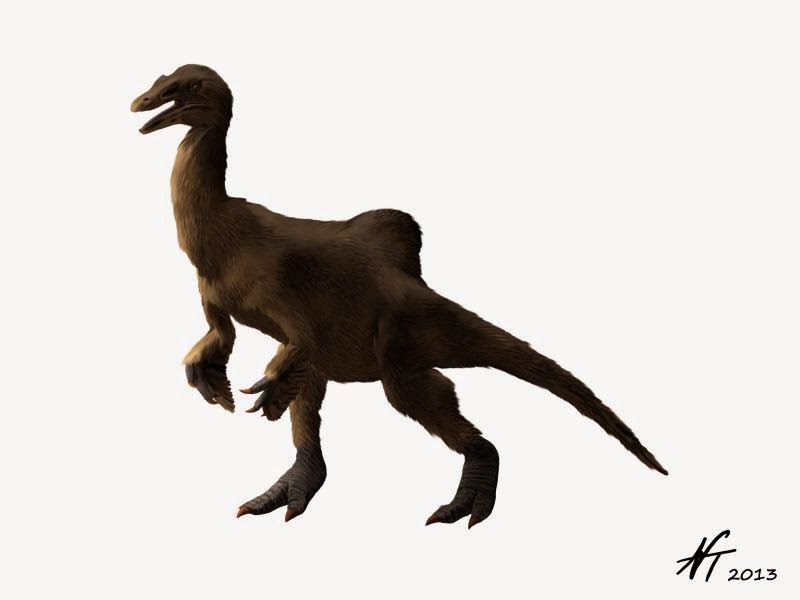
Deinocheirus the magnificent

A tentative recon of Deinocheirus while awaiting the official publication describing two new skeletons
Apparently, the mysterious Deinocheirus was more freaking awesome than you could ever have imagined... as recently revealed at SVP 2013! Here is the abstract:

New Specimens of Deinocheirus mirificus from the Late Cretaceous of Mongolia
Lee, Yuong-Nam; Barsbold, Rinchen; Currie, Philip; Kobayashi, Yoshitsugu &  Lee, Hang-Jae.

Abstract: The holotype of Deinocheirus mirificus was collected by the Polish-Mongolian Palaeontological Expedition at Altan Uul III in 1965. Because the holotype was known mainly on the basis of giant forelimbs with scapulocoracoids, Deinocheirus has remained one of the most mysterious dinosaurs. Two new specimens of Deinocheirus were discovered in the Nemegt Formation of Altan Uul IV in 2006 and Bugin Tsav in 2009 by members of the Korea-Mongolia International Dinosaur Expedition (KID). Except for the skull, middle dorsal and most of the distal caudal vertebrae, the right forelimb, left manus, and both pedes, the remaining parts of the skeleton (Mongolian Paleontological Center [MPC]-D 100/127) including a left forelimb clearly identifiable as Deinocheirus were collected. The humerus (993 mm in length) is longer than the 938 mm humerus of the holotype. The Altan Uul IV specimen (MPC-D 100/128) is a subadult Deinocheirus (approximately 72% of MPC-D 100/127), which consists of post-cervical vertebrae, ilia,ischia, and hind limbs. Both specimens provide important paleontological evidence for exact postcranial reconstruction of Deinocheirus mirificus. Cladistic analysis indicates that Deinocheirus is a basal member of Ornithomimosauria, but many new unique skeletal features appear to be quite different from other ornithomimosaurs. These include extreme pneumaticity of tall, anterodorsally oriented distal dorsal neural spines (7~8times taller than centrum height) with basal webbing, fused sacral neural spines forming a midline plate of bone that extends dorsally up to 170% of the height of the ilium, ventrally keeled sacral centra, a well-developed iliotibialis flange, a posterodorsally projecting posterior iliac blade with a concave dorsal margin, a steeply raised anteriordorsal margin of the ilium, an anteriorly inclined brevis shelf, vertically well-separatediliac blades above the sacrum, an completely enclosed pubic obturator foramen, triangular pubic boot in distal view, vertical ridges on anterior and posterior edges of medial surface of the femoral head, and a robust femur that is longer than tibiotarsus. These features suggest that Deinocheirus (unlike other ornithomimosaurs) was not a fast running animal, but a bulky animal with a heavily built pelvis and hind limbs. However,the dorsal ribs are tall and relatively straight, suggesting that the animal was narrow-bodied. A large number of gastroliths (>1100 ranging from 8 to 87 mm) were collected from the abdominal region of MPC-D 100/127, suggesting Deinocheirus was an herbivore.

Original artworks on Paleoexhibit are copyrighted to Nobu Tamura. Do not use without permission (Email: nobu dot tamura at yahoo dot com). Check out my portfolio at spinops.blogspot.com.

Saturday, August 17, 2013

New Multituberculate fossil shows keys to their success

Reconstruction of Rugosodon eurasiaticus.
Multituberculates are a highly successful group of early mammals and they were surprisingly long lived having evolved in the Jurassic, survived the KT extinction event before disappearing during the Oligocene period. They are in fact the most long-lasting group of mammals, having survived at least 130 million years, more than any other group of mammals either alive or extinct. A new mostly complete fossil discovered in China, Rugosodon eurasiaticus, greatly help clarify the origin of the group. It shows that some of the key characteristics of the multituberculates, such as highly flexible spine and mobile ankle joints, evolved very early, and were probable the reasons of their success.

Reference:

Ref: Yuan C.-X., Ji Q., Meng Q.-J., Tabrum A. R., Luo Z.-X. 2013. Earliest evolution of multituberculate mammals revealed by a new Jurassic fossil. Science 341 (6147): 779–783

Abstract: Multituberculates were successful herbivorous mammals and were more diverse and numerically abundant than any other mammal groups in Mesozoic ecosystems. The clade also developed diverse locomotor adaptations in the Cretaceous and Paleogene. We report a new fossil skeleton from the Late Jurassic of China that belongs to the basalmost multituberculate family. Dental features of this new Jurassic multituberculate show omnivorous adaptation, and its well-preserved skeleton sheds light on ancestral skeletal features of all multituberculates, especially the highly mobile joints of the ankle, crucial for later evolutionary success of multituberculates in the Cretaceous and Paleogene. 


Original artworks on Paleoexhibit are copyrighted to Nobu Tamura. Do not use without permission (Email: nobu dot tamura at yahoo dot com). Check out my portfolio at spinops.blogspot.com.

Thursday, August 15, 2013

And then there were nine...

The top right species is now synonymous with the top left one.

Up to 15 species of Psittacosaurus have been described in the scientific litterature, but a few are dubious and others have been shown to be synonymous. With the latest 3D geometric morphometric study of the skulls of the three species of Psittacosaurids from the Lujiatun beds of the Yixian Formation of China, this number is now down to nine: Hongshanosaurus houi and Psittacosaurus major are now taxonomically dead...

Psittacosaurus lujiatunensis

Here is the paper and abstract:
Hedrick BP, Dodson P (2013) Lujiatun Psittacosaurids: Understanding Individual and Taphonomic Variation Using 3D Geometric Morphometrics. PLoS ONE 8(8): e69265.

Abstract:

Psittacosaurus is one of the most abundant and speciose genera in the Dinosauria, with fifteen named species. The genus is geographically and temporally widespread with large sample sizes of several of the nominal species allowing detailed analysis of intra- and interspecific variation. We present a reanalysis of three separate, coeval species within the Psittacosauridae; P. lujiatunensis, P. major, and Hongshanosaurus houi from the Lujiatun beds of the Yixian Formation, northeastern China, using three-dimensional geometric morphometrics on a sample set of thirty skulls in combination with a reevaluation of the proposed character states for each species. Using these complementary methods, we show that individual and taphonomic variation are the joint causes of a large range of variation among the skulls when they are plotted in a morphospace. Our results demonstrate that there is only one species of Psittacosaurus within the Lujiatun beds and that the three nominal species represent different taphomorphotypes of P. lujiatunensis. The wide range of geometric morphometric variation in a single species of Psittacosaurus implies that the range of variation found in other dinosaurian groups may also be related to taphonomic distortion rather than interspecific variation. As the morphospace is driven primarily by variation resulting from taphonomic distortion, this study demonstrates that the geometric morphometric approach can only be used with great caution to delineate interspecific variation in Psittacosaurus and likely other dinosaur groups without a complementary evaluation of character states. This study presents the first application of 3D geometric morphometrics to the dinosaurian morphospace and the first attempt to quantify taphonomic variation in dinosaur skulls.

Original artworks on Paleoexhibit are copyrighted to Nobu Tamura. Do not use without permission (Email: nobu dot tamura at yahoo dot com). Check out my portfolio at spinops.blogspot.com.

Saturday, July 27, 2013

The Late Permian Diapsids, Part I

The Late Permian Diapsids, Part I


In a previous post, I have covered the emergence of the diapsids during the Late Carboniferous and Early Permian. We don't really know what happened next as the diapsidian fossil record is unfortunately very sketchy between the Kungurian when we left Araeoscelis gracilis and the very end of the Late Permian period when diapsids reappear as fossils in reasonable number at a handful of locations on the planet.
 Fig. 1.- Reconstructed skull of Lanthanolania ivakhnenko (after Modesto et al., 2003).


Through the entire Middle Permian, the diapsids constitute what scientists call a 'ghost lineage': we merely know they were there because their existence is attested before and after that time but no fossil has been found dating from that period. Well, almost... there is one single partial skull discovered in the Mezen River basin in the Arkhangel'sk province of Russia which was named Lanthanolania ivakhnenko (Modesto et al, 2003). This was a small neodiapsid, probably no more than 30 cm long judging from the 3 cm small skull. The fossil is the only diapsid found among hundreds of other amniote specimens in the Mezen river basin and was naturally overlooked, originally labeled as yet another specimen of the synapsid Mesenosaurus (the generic name Lanthanolania means 'forgotten ripper').  Diapsids were obviously a rare thing at that time, living in the shadows of the larger and more successful synapsids, anapsids and enormous amphibians. The specimen dates from the Uppermost Kazanian or the lowermost Tatarian around 260 MYA which translates into anything between the ICS Wordian (~265 MYA) and the ICS Wuchiapingian (~257 MYA) stages. Although the discovery of Lanthanolania created a little sensation among the specialists in filling the gap, it did not say much on the evolution of the group partly due to the quite fragmentary nature of the finds. All we know is that between the Early Permian and the Late Permian, the Araeoscelids were gone forever and that the terrestrial Neodiapsids survived and somehow diversified. 
Fig 2.- Reconstruction of Youngina capensis.


In the Late Permian, a motley crew of forms collectively and formerly called "Eosuchians" (which means “early crocs”) was present. The Eosuchians do not constitute a natural group and their classification and phylogenetic relations are a bit hazy. At first it appeared that the Eosuchians should be divided into the ancestors of the lepidosaurians (lizards, snakes and such) and the ancestors of the archosaurs (crocs, dinosaurs, etc...) but current understanding is that the story is more complicated than this. The most recent cladogram (Reisz et al., 2011) shows  a seemingly paraphyletic "younginiformes" group as the most basal eosuchians, with both terrestrial and aquatic forms, then the aquatic form Claudiosaurus (once thought to be a basal Sauropterygian), followed by some members of a family of terrestrial forms called "paliguanids", and finally the gliding coelurosauravids. None of them left any descendants and disappeared in the Early Triassic. Accompanying these "Eosuchians" in the Late Permian were the first members of the Archosauromorphs: the semi-aquatic protorosaurids.
Fig 3.- Skull of Youngina capensis.


Let's first go over the so-called "younginiformes", starting with the terrestrial ones. Youngina capensis was a small lizard-like creature that was first described from a partial skull (Broom, 1914) found in the Dicynodon assemblage zone of South Africa and dating from the latest Permian period. Youngina lived alongside a rich fauna of synapsids, including dicynodonts, gorgonopsids and biarmosuchians and anapsid reptiles, in what was a semi-arid environment. Since its original description, several fossils of Youngina, mostly skulls, were found, receiving different names (Youngoides, Youngopsis, etc...) that are all now considered to be synonymous to Youngina. One peculiar characteristics of Youngina is its single row of osteoderms on its back. A remarkable discovery consists of a set of 5 juvenile, fully articulated and complete individuals, indicating that those critters most certainly lived in a den (Smith &Evans, 1996).

The next two taxa are only tentatively placed among the younginids. Galesphyrus capensis, also described by Broom in 1914 is from the base of the Cistecephalus assemblage zone of South Africa (thus older than Youngina) and is known from a partial postcranial skeleton. Heleosuchus griesbachi, originally described by Owen (1876) as a species of Saurosternon, is known from a single specimen consisting of the posterior part of the skull and a partial postcranial skeleton. The fossil was thought to be lost until relocated in the Natural History Museum in Vienna, Austria (Carrol, 1987). The specimen is from South Africa from an unknown horizon and would date either from the Late Permian or the Early Triassic. Without good skull material, getting the exact affinities of these two animals is very difficult.
Fig 4.- Reconstruction of Thadeosaurus colcanapi.


From the Lower Sakamena formation of southern Madagascar originates Thadeosaurus colcanapi (Carroll, 1981) which is based on two nearly complete skeletons missing the skull and the lower parts of the limbs. This one was originally thought to belong to the European genus Datheosaurus, which is now known to be synonymous with the pelycosaur Haptodus (thus a Synapsid … it seems many of these early diapsids were first mistaken with a synapsid). As an intended pun, the name Thadeosaurus is simply an anagram of the name Datheosaurus, the only deliberate anagram of an animal scientific name that I am aware of. Thadeosaurus is known from several specimens, including juveniles, many being at first confused with the Tanzanian Tangasaurus (Currie & Carrol, 1984). It was a small lizard like creature measuring perhaps about 60 cm in length and characterized by a very long tail. Although found in marine strata, Thadeosaurus has no obvious adaptation for swimming indicating it was most probably a coastal fully terrestrial animal. The interesting thing about the Lower Sakamena formation is that this aquatic deposit contains an unusually large proportion of diapsid reptiles as compared to any other upper Permian deposits in the world. This is quite anomalous and the exact age of the deposits can be questioned. The age is based on palynological (fossil pollen) evidence and correlation of the vertebrate fauna with South Africa. One index fauna is the procolophonid Barasaurus which is similar to the South African Owenetta. But the latter was later also found in Early Triassic strata.

Let us conclude this tour of the terrestrial younginiformes with Kenyasaurus mariakanensis from the Early Triassic Maji-Ya-Chumvi formation of Kenya (Harris & Carroll, 1977). It is known from a single specimen lacking the skull and most of the pectoral girdle and forelimb, making its affinities hard to establish. This one was recently kicked out of the younginiformes. Like Thadeosaurus, it was found in marine strata but does not appear to have any specialization for aquatic environment. Therefore, it was probably a terrestrial form which measured about 50 cm in length.

Note also that two animals of that time, Heleosaurus and Apsisaurus, once considered being younginiformes turn out to be Synapsids of the varanopid sort.

Next, the marine “younginiformes”…

References:

Carroll, R. (1981). Plesiosaur ancestors from the Upper Permian of Madagascar. Philosophical Transactions of the Royal Society of London. Series B, Biological Sciences, 293(1066), 315-383.

Carroll, R. (1987). Heleosuchus: An enigmatic diapsid reptile from the Late Permian or Early Triassic of southern Africa. Canadian Journal of Earth Sciences, 24, 664-667.

Currie, P., & Carroll, R. (1984). Ontogenetic changes in the eosuchian reptile Thadeosaurus. Journal of Vertebrate Paleontology, 4(1), 68–84.

Harris, J., & Carroll, R. (1977). Kenyasaurus, a new eosuchian reptile from the Early Triassic of Kenya. Journal of Paleontology, 51(1), 139-149.

Modesto, S., & Reisz, R. (2003). An enigmatic new diapsid reptile from the Upper Permian of Eastern Europe. Journal of Vertebrate Paleontology, 22(4), 851-855.

Olson, E. (1936). Notes on the skull of Youngina capensis Broom. The Journal of Geology, 44(4), 523-533.

Reisz, R. R., Modesto, S. P.  and Scott, D. M. (2011). A new Early Permian reptile and its significance in early diapsid evolution. Proceedings of the Royal Society B 278, 3731-3737

Smith, R., & Evans, S. (1996). New material of Youngina: evidence of juvenile aggregation in Permian diapsid reptiles. Palaeontology, 39(2), 289-303.

Tuesday, January 1, 2013

2012 in Paleontology


It’s time for a retrospective of year 2012 in the paleontological field. Many species were described that year and apart from a few obvious ones, it was quite difficult to decide what should make up the top ten stories. After multiple hesitations, here is my pick (not in particular order of importance):


1.- The Kelheim theropod unveiled in 2011 received its official scientific name as Sciurumimus albersdoerferi. More surprisingly, it turns out to be a Megalosauroid, making it the theropod the most distantly related to birds to show direct evidence of feathers.

Reference: O. W. M. Rauhut, C. Foth, H. Tischlinger and M. A. Norell. 2012. Exceptionally preserved juvenile megalosauroid theropod dinosaur with filamentous integument from the Late Jurassic of Germany. Proceedings of the National Academy of Sciences 29:11746-11751.

2.- At 9 meter in length, Yutyrannus huali is the largest dinosaur showcasing direct evidence of feathers. Yutyrannus is also a tyrannosauroid, moving the at least partial feather coverage idea for Tyrannosaurus rex, from good probability to almost certainty.

Reference: X. Xu, K. Wang, K. Zhang, Q. Ma, L. Xing, C. Sullivan, D. Hu, S. Cheng, and S. Wang. 2012. A gigantic feathered dinosaur from the Lower Cretaceous of China. Nature 484:92-95

3.- Echinoderms (starfish, urchins, sea lilies, etc…) are unique among animals in having a body with a fivefold symmetry. We know from embryology that they must have evolved from bilateral ancestors. The fossil record finally confirmed this with the discovery of Ctenoimbricata spinosa, a sea floor spiny animal which proved to be an early echinoderm with bilateral symmetry.

Reference: S. Zamora, I. A. Rahman, and A. B. Smith. 2012. Plated Cambrian Bilaterians Reveal the Earliest Stages of Echinoderm Evolution. PLoS ONE 7(6):e38296:1-e38296:11.

4.- Microraptor, the four-winged dinosaur that already made the headlines last year when it was discovered to feed on birds, reveals its true colors: the study of fossil pigments indicates it had the plumage of a crow: metallic black.

Reference: Q. Li. 2012. Reconstruction of Microraptor and the Evolution of Iridescent Plumage. Science 335: 1215-1219.

5.- Evidence of feathers was also found in the North American ostrich-mimic dinosaur Ornithomimus edmontonicus. While the body was covered with downy feathers, the arms in the adults had wing feathers, suggesting that mating display was the initial purpose of those, not flight.

Reference: D. K. Zelenitsky, F. Therrien, G. M. Erickson, C. L. Debuhr, Y.  Kobayashi, D. A.  Eberth, F.  Hadfield,   2012. Feathered Non-Avian Dinosaurs from North America Provide Insight into Wing Origins. Science 338 (6106): 510.

6.-  Mosasaurs form a group of highly specialized predators from the Late Cretaceous period,  related to modern day monitor lizards and perfectly adapted for swimming. The fossil of Pannoniasaurus inexpectatus is the first evidence that these predominantly marine creatures have also conquered freshwater.

Reference: L. Makádi, M. W. Caldwell, and A. Osi. 2012. The first freshwater mosasauroid (Upper Cretaceous, Hungary) and a new clade of basal mosasauroids. PLoS ONE 7(12):e51781.

7.-  Nyasasaurus parringtoni known from very fragmentary remains might have been the earliest representative of the dinosaur clade.

Reference: S. J. Nesbitt, P. M. Barrett, S. Werning, C. A. Sidor, and A. J. Charig. 2013. The oldest dinosaur? A Middle Triassic dinosauriform from Tanzania. Biology Letters 9(1):1-5.

8.- A morphometric study of archosaur skulls indicate that birds have the skull of baby dinosaurs. Our avian friends may have therefore evolved from neotenic dinosaurs retaining their juvenile characteristics through adulthood.

Reference: Bhullar, B., Marugán-Lobón, J., Racimo, F., Bever, G., Rowe, T., Norell, M., & Abzhanov, A. 2012. Birds have paedomorphic dinosaur skulls. Nature, 487, 223-226.

9.- A new phylogenetic analysis of the enigmatic Miocene creature known as Necrolestes patagonensis indicates that it was a survivor of an ancient lineage of primitive mammals thought to have disappeared at the end of the Cretaceous: the Meridiolestids.

Reference: G. W. Rougier, J. R. Wible, R. M. D. Beck and S. Apesteguía. 2012. The Miocene mammal Necrolestes demonstrates the survival of a Mesozoic nontherian lineage into the late Cenozoic of South America. Proceedings of the National Academy of Sciences of the United States of America 109 (49): 20053–20058.


10.- The Cetotheriids are a family of baleen whales that appeared during the Late Oligocene and thought to be extinct since the Late Pliocene. Not anymore: a new phylogenetic analysis indicates that the living Pygmy Right Whale (Caperea marginata) is in fact a modern surviving representative of this family.

Reference: R. E. Fordyce and F. G. Marx. 2013. The pygmy right whale Caperea marginata: the last of the cetotheres. Proceedings of the Royal Society B: Biological Sciences 280 (1753): 20122645.

Original artworks on Paleoexhibit are copyrighted to Nobu Tamura. Do not use without permission (Email: nobu dot tamura at yahoo dot com)

Sunday, December 2, 2012

Humble beginnings for the mighty diapsids: the Araeoscelids and Orovenator

The amniotes (those initially four-legged creatures that produce "amniotic eggs", i.e. eggs adapted for land life) are traditionally divided into a few branches depending on some key characteristics of their skull, and the diapsids appear to be the most successful of all these branches. Virtually all living vertebrates that we commonly name "reptiles" are  diapsids: crocs, lizards, snakes, the whole lot of them... Diapsids also include the birds by way of their forebears, the dinosaurs. In contrast, mammals and their ancestors belong to the synapsid branch of the amniotes. The distinction between diapsid and synapsid lays in the number of holes (scientist called those "fenestrae" which means windows) in the skull just behind the eye socket. Diapsids typically have two, the supratemporal (or upper temporal) fenestra on top and the infratemporal (or lower temporal) fenestra below. Synapsids only have one,  the bottom infratemporal fenestra, simply called temporal fenestra. Both diapsids and synapsids evolved from more primitive reptiles with no opening behind the eye: the anapsids. The distinction between the different type of skulls are depicted in Figure 1. 

Fig 1.- Different type of skulls among reptiles. Top left: anapsid skull of Procolophon trigonoceps (after Romer, 1956) top right: diapsid skull of Petrolacosaurus kansensis (after Reisz, 1981), bottom: synapsid skull of Eothyris parkeri (after Reisz et al., 2009).

The distinction seems simple enough but only reflects the primitive initial condition. Evolution indeed loves playing tricks. The same way that we know that dolphins are really mammals and not some strange air-breathing fish, scientists figured that everybody's favorite marine mesozoic  reptiles, the plesiosaurs and ichthyosaurs, are really diapsids in disguise. Their skulls only have one opening behind the eye socket, the supratemporal fenestra, a condition which is called 'euryapsid'. The euryapsids used to be considered as a fourth branch of reptiles, but carefull examinations of the fossils show they evolved from diapsid ancestors and that the loss of the infratemporal fenestra is only a secondary characteristics. More tricky are the turtles. These do not have any opening behind the eye which classified them as "anapsids". However, nowadays, it seems quite firmly established that they too are highly modified diapsid reptiles, although it took scientists quite a while to figure this one out. Now look a the highly modified skulls of birds and snakes: you will have hard time recognizing any of the original temporal openings in them, but since their ancestors were diapsid reptiles, by way of basic phylogeny law (you shall belong to the same clade as your ancestors, ... i.e the monophyly principle), they too are diapsid reptiles. 

That being said, the diapsids then really are the most successful group of amniotes with some 18,000 species, including birds, alive today (compared to the 5700 species of mammals representing the only survivors of the synapsid branch). But what is their origin? They probably evolved during the Late Pennsylvanian from a group of anapsid ancestors to which such lizard-like creatures as Paleothyris and Hylonomus belong to.  But this is not at all very clear because of the scarcity of the fossil record. The first true diapsids are a family of small superficially lizard-like creatures called Araeoscelidia, to which Petrolacosaurus and Araeoscelis are the best known representatives. The fossil record of the Araeoscelids extends from the Late Carboniferous to the Early Permian. 

Fig 2.- a reconstruction of Petrolacosaurus kansensis.

The most ancient known diapsid is Petrolacosaurus kansensis from the Late Pennsylvanian (the North American 'Missourian' stage which corresponds to the ICS Kasimovian stage, ~305 MYA) of Kansas. The generic name means "rock lake reptile" in reference to the "Rock Lake Shale" in which the type specimen (a nearly complete hind limb) was found. Although originally described in 1945 as a pelycosaur (thus a synapsid), it was not until 1977 after new specimens including the skull with its two characteristic openings, were thoroughly described, that it was realized to be the earliest known diapsid, raising the little critter from relative obscurity to paleontological stardom. In a world dominated by giant arthropods and fearful amphibians,  Petrolacosaurus was indeed relatively small, measuring probably about 70 to 80 cm in length, accounting for the long tail.

Fig 3.- Reconstruction of Spinoaequalis schultzei.

Also from the Late Pennsylvanian of Kansas but a bit later (from the Calhouns Shale formation dated to the North American 'Virgilian' stage roughly corresponding to the ICS Gzhelian, ~ 300 MYA), comes Spinoaequalis schultzei. This early diapsid is a bit smaller (30 cm) and is only tentatively placed among the araeoascelids. The interesting note about this critter is the tail:  the tall and equal size neural and haemal spines of the caudal vertebra (thus the generic name) which gives the distinct tall and laterally compressed shape to the tail is viewed as an adaptation for swimming, a good indication that Spinoaequalis was an aquatic animal. This is supported by the fact that its fossil was discovered in freshwater deposits among remains of spiny sharks (acanthodians) and other fully aquatic animals. However, the long and slender limbs, are those of a terrestrial animal, an indication that it wasn't fully aquatic. In any case,  this makes Spinoaequalis the first amniote to have ever returned  to water since their epic conquest of the dry lands.

Fig 4.- Skulls of Araeoscelis gracilis (after Reisz et al., 1984).
 
Araeoscelis dates from the Early Permian and was originally described in 1910 as a lizard. It has the same body plan than Petrolacosaurus but the skull was more massive with strong teeth, ideal for crushing the heavy exoskeleton protecting some of the arthropods of that time. Araeoscelis was about the same size too, with an estimated length of 70-80 cm accounting for the unknown tail. As a probable adaptation of its specialized diet, the lower temporal fenestra has closed making the skull more robust. Araeoscelis, has therefore this 'euryapsid' condition that will be common to the large marine predators of the Mesozoic.  Two species have been  described, A. gracilis from the Arroyo Formation of Texas (Kungurian age, ~275 MYA), known from several fairly complete specimens, and A. casei from the Admiral Formation of Texas (Artinskian age, ~285 MYA), known from at least seven individuals. The two are virtually indistinguishable and the separation into distinct species seems only to be justified by their difference in age, A. casei being from slightly (~ 10 millions years) older rocks than A. gracilis

Fig 5.- Reconstruction of Araeoscelis gracilis.

The other Araeoscelids are poorly known and all date from the Early Permian. The 70 cm long Dictybolos tener from the Wellington formation of Oklahoma (~280 MYA) is known from isolated bones from numerous individuals. This one was presumably semi-aquatic and a fish eater. Zarcasaurus tanyderus from the Cutler Formation of New Mexico is known from a partial disarticulated skeleton. Characterized by its rather long neck vertebrae, it was a close relative of Araeoscelis. In Europe, the rather dubious Aphelosaurus lutevensis from the Tuilières formation of South Central France and first described in the 19th century,  is another possible Araeoscelid, though it is hard to tell without any knowledge of a crucial piece of fossil information: the skull. Similarly, Kadaliosaurus priscus from the Rotliegend of Germany is only known from a postcranial skeleton and its classification among the araeoscelids is only tentative.

Fig 6.- Reconstructed skull of Orovenator mayorum (after Reisz et al., 2011).

Besides the Araeoscelids, there is one additional diapsid dating from the Early Permian, Orovenator mayorum discovered in one of the fissure fills of the Richards Spur locality of Oklahoma, and known from two partial crushed skulls. Orovenator has the distinction of being the earliest known and most primitive of the Neodiapsids, a clade that contains all the known diapsids except for the araeaoscelids. This was a small animal with an elongated skull half the length of those of Petrolacosaurus and Araeoscelis. The Richards Spur locality with its distinct Early Permian fauna of some 30 taxa of fully terrestrial vertebrates, is thought to originate from an upland ecosystem, which would only fossilized in very exceptional cases. This is in sharp contrast to the Araeoscelids which were all found in lowland swampy habitats, with better chances for fossilization. The hypothesis is therefore that the initial split of the early diapsids into the Araeoscelids and the Neodiapsids is the result of adaptation to two different habitats, with the Araeoscelids in the lowlands and the Neodiapsids in the uplands.

In conclusion, the early diapsids show a surprising degree of diversity with some forms that became at least partially aquatic (Spinoaequalis, Dictybolos) while others adapted to the harsher conditions of the uplands (Orovenator).  There is also evidence of a quite specialized diet for some (Araeoscelis). However, the remains of these animals are quite rare and there is a rather long gap in the fossil record before we see them appear again in the Late Permian. Their number would not significantly increase before the Early Triassic. It is somewhat tempting to imagine that like the mammals of the Mesozoic dominated by the dinosaurs, the early diapsids lived in the relative shadow of the other reptiles for some 50 million years,  when the world was dominated by  larger synapsids, anapsids and  amphibians and that it will take the massive Permian-Triassic extinction event to see the diapsids finally take the upper hand.


References:

Brinkman, D., Berman, D., & Eberth, D. (1984). A new araeoscelid reptile, Zarcasaurus tanyderus from the Cutler Formation (Lower Permian) of north-central New Mexico. New Mexico Geology, 34–39. 

Debraga, M., & Reisz, R. (1995). A new diapsid reptile from the uppermost carboniferous (Stephanian) of Kansas. Palaeontology, 38(1), 199–212. 

Lane, H. (1945). New mid-Pennsylvanian reptiles from Kansas. Transactions of the Kansas Academy of Science (1903-), 47(3), 381–390. 

Olson, E. (1970). New and little known genera and species of vertebrates from the Lower Permian of Oklahoma. Fieldiana: Geology, 18(3), 359–434. 

Reisz, R. R. (1977). Petrolacosaurus, the oldest known diapsid reptile. Science, 196(4294), 1091–3. 

Reisz, R., Berman, D., & Scott, D. (1984). The anatomy and relationships of the Lower Permian reptile Araeoscelis. Journal of Vertebrate Paleontology, 4(1), 57–61. 

Reisz, R. R., Modesto, S. P., & Scott, D. M. (2011). A new Early Permian reptile and its significance in early diapsid evolution. Proceedings. Biological sciences / The Royal Society, 278(1725), 3731–7. 

Williston, S. (1910). New Permian reptiles: rhachitomous vertebrae. The Journal of Geology, 18(7), 585–600. 

Williston, S. (1913). The skulls of Araeoscelis and Casea, Permian reptiles. The Journal of Geology, 21(8), 743–747.


Original artworks on Paleoexhibit are copyrighted to Nobu Tamura. Do not use without permission (Email: nobu dot tamura at yahoo dot com)

Sunday, August 19, 2012

The Lossiemouth Sandstone Formation of Scotland


            The yellowish sandstone of the Lossiemouth Sandstone Formation can be found on the coast near Elgin, in the Moray council area, north east of Scotland (Fig 1). Fossils were collected there in different quarries, around the town of Lossiemouth, at the end of the 19th and beginning of the 20th century, notably by the ardent collector William Taylor of Lhanbryde (1849-1921). The sand from the sandstone was probably carried by wind and deposited over a fluvial area, indicating that the location during the Late Triassic was a sand dune desert with narrow strips of lowland vegetation around rivers. The sandstone did not preserve any index fossil such as pollens, plants or invertebrates, and no radiometric dating could be performed, leading to some uncertainties on the exact age of the rocks. However, based on the correlation of the Lossiemouth vertebrate fauna with those of the Maleri Formation of India, the Santa Maria Formation of Brazil, the Ischigualasto Formation of Argentina, a Late Carnian age is generally attributed to the sandstone. The fauna is represented by eight taxa of reptiles, including six archosaurs.

Fig. 1.- Location of the Lossiemouth Sandstone Formation today (left) and during the Late Triassic (right).

Saltopus elginensis Huene, 1910 ("Elgin's hopping foot"), is known from a single badly preserved skeleton. The exact affinity of this small (60 cm long) bipedal predator has been debated for decades. It was at some point classified as an early theropod dinosaur but more recent analysis put it within the dinosauriformes but outside the Dinosauria clade as a sister taxon to them (It means Saltopus is not a dinosaur but one of its closest relatives). Since the skull in the fossil is missing, the diet of this animal is unknown.

Another interesting animal from the Carnian of Scotland is Scleromochlus taylori Woodward, 1907 ("Taylor's hard fulcrum") (Fig 2). This rather strange 1.8 m long creature looks a bit like a lizard on long slender legs. It was related or even has been considered ancestral to the pterosaurs, a group of archosaurs that will eventually  conquer the air. Several skeletons of this animal are known.

Fig 2.- Reconstruction of Scleromochlus taylori.

The 4 meter long and probable top predator of its time, Ornithosuchus longidens ("long-toothed bird crocodile") (Huxley, 1877) (Fig. 3) belongs to another group of facultative bipedal carnivorous reptiles distantly related to crocodiles, the Ornithosuchians. They were equipped with sharp teeth and a row of bony scales (osteoderms) along their back and tail. Ornithosuchus was once thought to be ancestral to the theropod dinosaurs, but details of its skeletal anatomy such as the braincase and the configuration of the ankle show that it was a Crurotarsi like the Rauisuchians, the Aetosaurs, crocodiles and phytosaurs and not an Avemetatarsalia (Dinosaurs and Pterosaurs).

Fig. 3- Reconstruction of Ornithosuchus longidens.

Erpetosuchus granti Newton, 1894 ("Grant's Snake Crocodile") was a small (60 cm long) agile quadrupedal predator that might have hunted small lizards and amphibians (Fig 4). Erpetosuchus was the Lossiemouth fossil the most closely related to modern crocodiles and is known from at least four specimens. Considering the location of Scotland at that time (Fig 1), it is no surprise that an additional fossil referable to the same animal was discovered in the New Haven Formation of Connecticut, United States.

Fig. 4.- Reconstruction of Erpetosuchus granti.

Herbivores are represented by several groups of reptiles. The rhynchosaurs had stocky bodies with a broad skull and a powerful beak. They may have fed on tough vegetation, such as the seed ferns which were abundant at that time. In Europe, Rhynchosaurs were represented by the 1.3 meter long  Hyperodapedon gordoni Huxley, 1859 ("Gordon's best pestle tooth") from Scotland (Fig. 5). It is known from at least 35 individuals, making it the most abundant vertebrate fossils of the formation. The fossils came into various sizes, reflecting ages, that can be grouped into two general types (morphotypes) possibly indicating sexual dimorphism. The genus Hyperodapedon had a worldwide distribution, with several species described from India, Brazil, Argentina. Zimbabwe, Madagascar, Tanzania and the United states. They had therefore been used to correlate different formations across the globe, serving as an "index" fossil.

Fig. -5. - A pair of Hyperodapedon gordoni.

Aetosaurs were heavily armored  archosaurs, with a body covered with plate-like scutes (osteoderms) and spikes. These vegetarian animals were also distantly related to crocodiles and are now thought to have been fully terrestrial animals. The carnian representives in Europe include the genera Stagonolepis and Paratypothorax, with Stagonolepis robertsoni Agassiz, 1884 ("Robertson's pitted scale") being the Lossiemouth species (Fig. 6). It measured about 3 meters in length. The remains of Stagonolepis were originally mistaken for fish scales, thus the generic name.

Fig. 6.- Stagonolepis robertsoni.

Procolophonids were small lizard like creatures belonging to the ancient lineage of reptiles called Parareptilia. By the end of the Triassic they have adopted a vegetarian diet before being wiped out by extinction at the end of the period. Leptopleuron lacertinum Owen, 1851 ("Lizard slender ribs") is a typical procolophonid that measured about 30 cm in length (Fig 7). It might have lived in burrows. This little critter was the subject of a bitter rivalry between famed paleontologists Richard Owen and Gideon Mantell at the end of the 19th century, both wanting to be first to describe the animal. Mantell christened the fossil Telerpeton elginense but Owen was quicker to publish so the name he gave has priority according to the international rules of nomenclature.

Fig. 7.- Reconstruction of Leptopleuron lacertinum.

The rhynchocephalians (and more restrictively, the sphenodontians) were once a successful and diverse group of lizard-like mesozoic reptiles with both aquatic and terrestrial forms. The only modern surviving member of the rhynchocephalians is the tuatara (Sphenodon) from New Zealand, generally presented as a true "living fossil". The Lossiemouth sandstone has yielded the species Brachyrhinodon taylori Huene, 1910 ("Taylor's short nose teeth") (Fig. 8) which was very similar to the tuatara in shape, but smaller, measuring some 25 cm in length, and with probably a similar lifestyle. Both Leptopleuron and Brachyrhinodon are known from numerous specimens.

Fig -8.- Reconstruction of Brachyrhinodon taylori.

All artworks on this page are copyrighted to Nobu Tamura. Do not use without permission. Contact: nobu dot tamura at yahoo dot com.

References:
Benton, M. (1983). The Triassic reptile Hyperodapedon from Elgin: functional morphology and relationships. Phil. Trans. R. Soc. Lond. B, 302(1112), 605–718.
Benton, M. (1999). Scleromochlus taylori and the origin of dinosaurs and pterosaurs. Phil. Trans. R. Soc. Lond. B, 354, 1423–1446.
Benton, M., & Walker, A. (2002). Erpetosuchus, a crocodile-like basal archosaur from the Late Triassic of Elgin, Scotland. Zoological Journal of the Linnean Society, 136, 25–47.
Benton, M. J., & Walker, A. D. (2011). Saltopus, a dinosauriform from the Upper Triassic of Scotland. Earth and Environmental Science Transactions of the Royal Society of Edinburgh, 101(3-4), 285–299.
Fraser, N. C., & Benton, M. J. (1989). The Triassic reptiles Brachyrhinodon and Polysphenodon and the relationships of the sphenodontids. Zoological Journal of the Linnean Society, 96(4), 413–445.
Olsen, P. E., Sues, H.-D., & Norell, M. A. (2000). First record of Erpetosuchus (Reptilia: Archosauria) from the Late Triassic of North America. Journal of Vertebrate Paleontology, 20(4), 633–636.
Säilä, L. K. (2010). Osteology of Leptopleuron lacertinum Owen, a procolophonoid parareptile from the Upper Triassic of Scotland, with remarks on ontogeny, ecology and affinities. Earth and Environmental Science Transactions of the Royal Society of Edinburgh, 101(01), 1–25.
Spencer, P. (2000). The braincase structure of Leptopleuron lacertinum Owen (Parareptilia: Procolophonidae). Journal of Vertebrate Paleontology, 20(1), 21–30.
Walker, A. (1961). Triassic reptiles from the Elgin area: Stagonolepis, Dasygnathus and their allies. Phil. Trans. R. Soc. Lond. B, 244(709), 103–204.
Walker, A. (1964). Triassic reptiles from the Elgin area: Ornithosuchus and the origin of carnosaurs. Phil. Trans. R. Soc. Lond. B, 248(744), 53–134.
Watson, D. M. S. (1909). On some Reptilian Remains from the Trias of Lossiemouth (Elgin). Quarterly Journal of the Geological Society, 65(1-4), 440–440.
Woodward, a. S. (1907). On a New Dinosaurian Reptile (Scleromochlus Taylori, gen. et sp. nov.) from the Trias of Lossiemouth, Elgin. Quarterly Journal of the Geological Society, 63(1-4), 140–144.